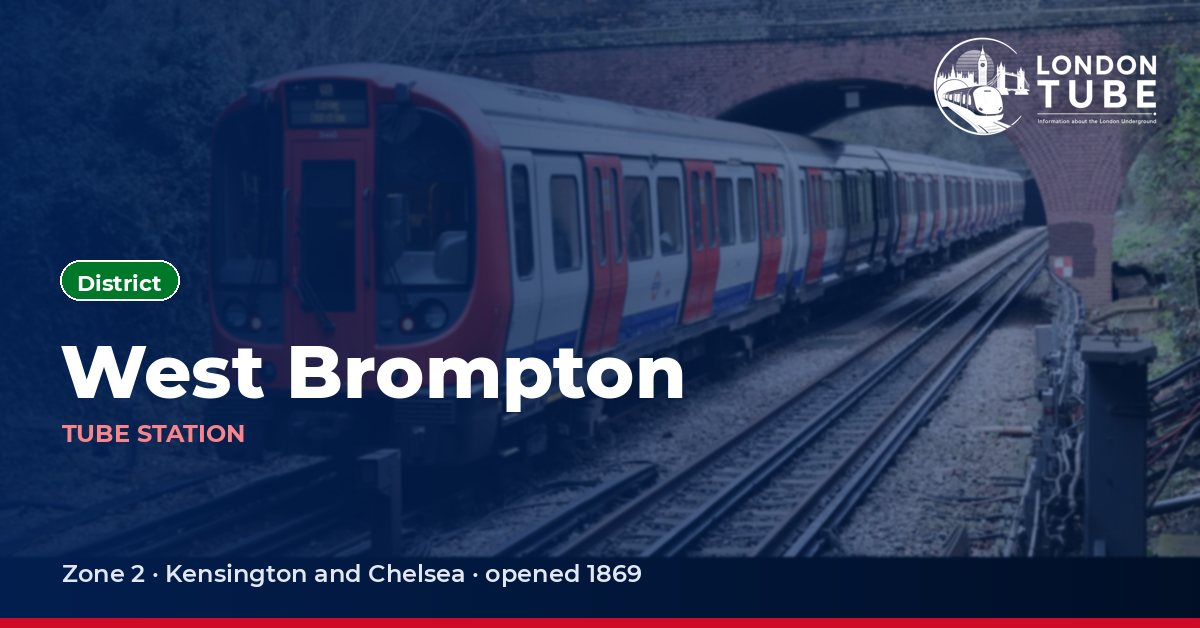
West Brompton tube station
District line · Zone 2 · Kensington and Chelsea
About West Brompton station
Railway history at this spot on Old Brompton Road predates the Underground. The West London Extension Joint Railway ran through from the early 1860s, though its own station only opened in 1866, and the original buildings were the work of Sir John Fowler. The District Railway arrived on 12 April 1869, placing its platforms next door as the terminus and only station of its extension from Gloucester Road; Earl’s Court did not open until 1871. Richmond Road had been proposed as a name before opening. A planned link between the two railways never materialised, and on 1 March 1880 the District pushed south to Putney Bridge. In the 1906 heat wave an electric rail warped here, and trains coasted over it until it was repaired.
After bomb damage, the West London line lost its passenger trains on 21 October 1940 and its platforms were later demolished, while the Underground carried on. New Network Rail platforms were opened on 1 June 1999 by the transport minister Glenda Jackson, as a plaque on the western lift tower records; their design, by Robinson Kenning and Gallagher of Croydon, echoes the decorative brickwork of the Victorian architect John Young. The Grade II-listed station sits in a cutting covered at one end. District trains use platforms 1 and 2 and the Mildmay line 3 and 4, all on one level, and the lifts give step-free access to the eastbound District platform but not the westbound one.
First and last trains from West Brompton
| Line and direction | Mon–Thu first – last | Friday first – last | Saturday first – last | Sunday first – last |
|---|---|---|---|---|
| District towards Wimbledon | 05:34 – 00:54 | 05:34 – 00:54 | 05:34 – 00:54 | 07:08 – 00:17 |
| District towards Edgware Road (Circle line), Tower Hill or Upminster | 05:11 to High Street Kensington – 01:06 to High Street Kensington | 05:11 to High Street Kensington – 01:06 to High Street Kensington | 05:11 to High Street Kensington – 01:06 to High Street Kensington | 07:06 – 00:18 to Earl's Court |
Times are TfL’s published timetable departures from this station; on Saturday the list follows TfL’s “Saturdays and public holidays” timetable.
At the busiest hour on a weekday there are up to 16 District trains an hour per direction from West Brompton, counting both directions separately.
Next stations from West Brompton
Running times between West Brompton and the adjoining stations, from TfL’s timetable.
| Line | Next station | Time |
|---|---|---|
| District | Earl's Court | 2.6 min |
| District | Fulham Broadway | 2.1 min |
Connections
- London Overground: Mildmay line.
- National Rail: Southern.
Station facilities
What is near West Brompton station
The tracks here mark a borough boundary, so the station serves streets in both Kensington and Chelsea and Hammersmith and Fulham. Brompton Cemetery lies immediately to the east, and the site of the demolished Earls Court Exhibition Centre is just to the north. Closer at hand are Columbia Gardens, about 90 m away, Lost River Park and The Gallery at roughly 160 m, and Lillie Square at about 190 m. Earl’s Court Square Garden (around 350 m) and the Finborough Theatre (about 390 m) are a little further.
| Place | Walk from the station |
|---|---|
| Columbia Gardens | 90 m |
| The Gallery | 160 m |
| Lillie Square | 190 m |
| Earl's Court Square Garden | 350 m |
| Finborough Theatre | 390 m |
Frequently asked questions
The District Railway opened its station in 1869 beside the West London Extension Joint Railway station of 1866, and the planned link between the two companies was never built. West London line passenger trains stopped in 1940 and those platforms were demolished, but new ones opened on 1 June 1999, so District, Overground and Southern trains now share the site.
Very easy. The Mildmay line platforms have no entrance of their own and are reached through the Underground station. District platforms 1 and 2 and Mildmay platforms 3 and 4 are on the same level; a fence runs between platforms 2 and 3, but it is possible to pass directly from one to the other.