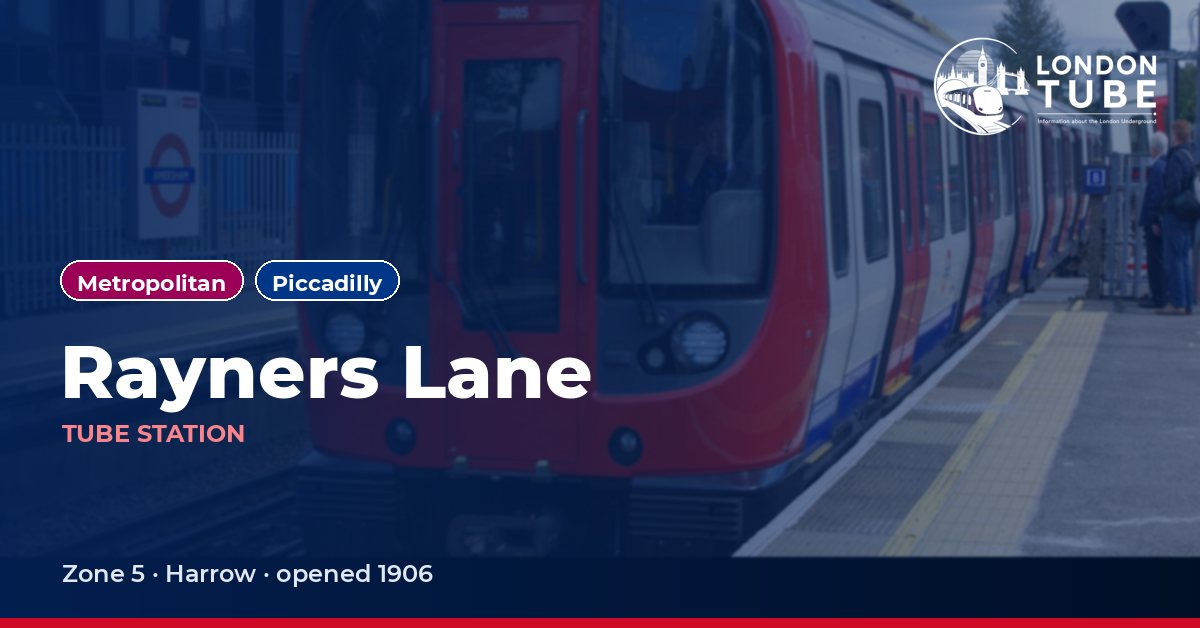
Rayners Lane tube station
Metropolitan line and Piccadilly line · Zone 5 · Harrow
About Rayners Lane station
A farmer called Daniel Rayner gave his name to the lane, and the lane gave its name to Rayners Lane Halt, opened by the Metropolitan Railway on 26 May 1906 on its Harrow to Uxbridge line. The stop stood so exposed that it was nicknamed Pneumonia Junction. A District line extension from South Harrow joined the Metropolitan at Rayners Lane junction on 1 March 1910, letting District trains run on to Uxbridge, and on 23 October 1933 Piccadilly line trains took over that service.
House building in the 1930s, in a development first named Harrow Garden Village, transformed the place: annual passengers rose from 22,000 in 1930 to 4 million in 1937. A temporary timber booking hall opened on 14 March 1935 while a new station by Charles Holden and Reginald Uren was built; it opened on 8 August 1938. Its large cube-shaped brick and glass ticket hall under a flat reinforced concrete roof is now Grade II listed. Just east of the platforms the Metropolitan and Piccadilly tracks meet, and a centre reversing siding to the west is where, during the day, half the Piccadilly service turns back. Two unused sidings south of the station were lifted in late 2017.
First and last trains from Rayners Lane
| Line and direction | Mon–Thu first – last | Friday first – last | Saturday first – last | Sunday first – last |
|---|---|---|---|---|
| Metropolitan towards Uxbridge | 05:47 – 01:11 | 05:47 – 01:11 | 05:47 – 01:11 | 07:09 – 00:45 |
| Metropolitan towards Aldgate, Baker Street or Harrow-on-the-Hill | 05:26 – 00:49 to Wembley Park | 05:26 – 00:49 to Wembley Park | 05:25 – 00:48 to Wembley Park | 06:50 – 00:28 to Wembley Park |
| Piccadilly towards Uxbridge | 06:03 – 01:20 | 06:03 – 01:20 | 08:16 – 01:20 | 08:17 – 00:25 |
| Piccadilly towards Cockfosters, South Harrow or Acton Town | 05:34 to Wood Green – 00:51 to Acton Town | 05:34 to Wood Green – 00:51 to Acton Town | 05:31 to Acton Town – 00:51 to Acton Town | 06:59 to Acton Town – 00:16 to Acton Town |
Times are TfL’s published timetable departures from this station; on Saturday the list follows TfL’s “Saturdays and public holidays” timetable.
At the busiest hour on a weekday there are up to 10 Metropolitan trains an hour per direction and 6 Piccadilly trains an hour per direction from Rayners Lane, counting both directions separately.
Next stations from Rayners Lane
Running times between Rayners Lane and the adjoining stations, from TfL’s timetable.
| Line | Next station | Time |
|---|---|---|
| Metropolitan | Eastcote | 3 min |
| Metropolitan | West Harrow | 2.2 min |
| Piccadilly | Eastcote | 2.8 min |
| Piccadilly | South Harrow | 4.8 min |
Connections
- Tube: change here between the Metropolitan line and Piccadilly line.
Station facilities
What is near Rayners Lane station
The station lies just west of the junction of Rayners Lane, Alexandra Avenue and Imperial Drive, in the middle of the 1930s suburb that grew up after the line arrived. Christ the Redeemer College is about 290 m away. It is mainly a commuter station for the surrounding residential district, with a car park, six Blue Badge spaces and bus routes 398, H9, H10 and H12 calling at the station. Here the Metropolitan line and Piccadilly line share the same platforms.
| Place | Walk from the station |
|---|---|
| Christ the Redeemer College | 290 m |
Frequently asked questions
The station, opened as Rayners Lane Halt in 1906, was named after a local farmer, Daniel Rayner. Its exposed position in open country earned it the nickname Pneumonia Junction before the 1930s housing boom built up the area around it.
Yes. The station designed by Charles Holden and Reginald Uren, which opened on 8 August 1938, is Grade II listed by Historic England. It is known for its large cube-shaped brick and glass ticket hall with a flat reinforced concrete roof.