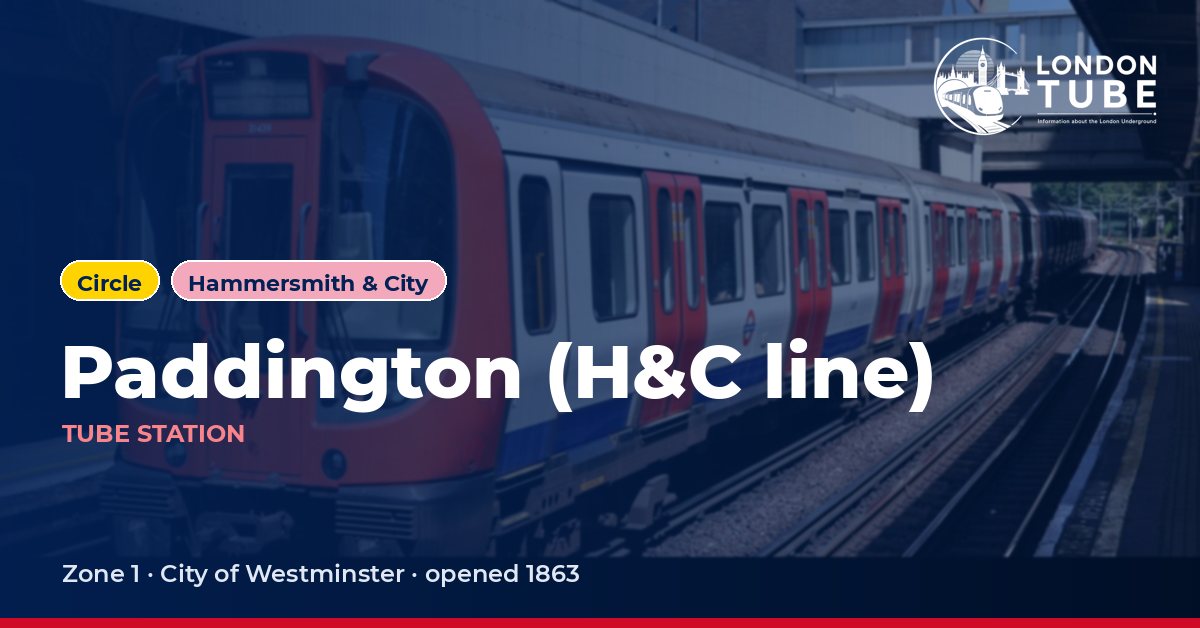
Paddington (H&C line) tube station
Circle line and Hammersmith & City line · Zone 1 · City of Westminster
About Paddington (H&C line) station
On 10 January 1863 the world’s first underground railway began here. Paddington (Bishop’s Road) was the Metropolitan Railway’s western terminus, its building set on the bridge carrying Bishop’s Road, now Bishop’s Bridge Road, over the Great Western Railway’s main-line tracks. The GWR supplied the first rolling stock, and the line to Farringdon was laid with dual-gauge track for broad- and standard-gauge trains. On 9 May 1864 a locomotive boiler exploded at the station. From 13 June 1864 GWR trains ran on to Hammersmith, at first over the main line for about a mile; delays there led to a separate pair of tracks, opened on 30 October 1871.
The station took its present name on 10 September 1933. Until 1990 its trains were shown on maps as part of the Metropolitan line, after which the route became the Hammersmith & City line. Circle line trains arrived in December 2009, when that line was reshaped into a spiral running on from Edgware Road to Hammersmith. A rebuild in 2012 and 2013 lengthened the platforms, improved connections with the main-line station and added an entrance to Paddington Basin. It remains a separate station from the Praed Street Paddington, with which it is linked only through the main-line concourse.
First and last trains from Paddington (H&C line)
| Line and direction | Mon–Thu first – last | Friday first – last | Saturday first – last | Sunday first – last |
|---|---|---|---|---|
| Circle towards Hammersmith (Circle and H&C lines) | 05:22 – 00:57 | 05:22 – 00:57 | 05:22 – 00:57 | 07:35 – 00:43 |
| Circle towards Edgware Road (Circle line) | 05:01 – 23:46 | 05:01 – 23:46 | 05:01 – 23:46 | 06:35 – 23:18 |
| Hammersmith & City towards Hammersmith (Circle and H&C lines) | 05:45 – 00:51 | 05:45 – 00:51 | 05:45 – 00:51 | 07:11 – 00:29 |
| Hammersmith & City towards Barking or Plaistow | 05:15 – 00:34 | 05:15 – 00:34 | 05:15 – 00:34 | 07:03 – 00:12 |
Times are TfL’s published timetable departures from this station; on Saturday the list follows TfL’s “Saturdays and public holidays” timetable.
At the busiest hour on a weekday there are up to 7 Circle trains an hour per direction and 7 Hammersmith & City trains an hour per direction from Paddington (H&C line), counting both directions separately.
Next stations from Paddington (H&C line)
Running times between Paddington (H&C line) and the adjoining stations, from TfL’s timetable.
| Line | Next station | Time |
|---|---|---|
| Circle | Edgware Road (Circle line) | 2.5 min |
| Circle | Royal Oak | 2 min |
| Hammersmith & City | Edgware Road (Circle line) | 2.6 min |
| Hammersmith & City | Royal Oak | 1.8 min |
Connections
- Tube: change here between the Circle line and Hammersmith & City line.
- Buses: 7, 16, 23, 27, 36 (night buses N205, N27, N7).
- Elizabeth line at this station.
- National Rail: Great Western Railway and Heathrow Express.
Station facilities
What is near Paddington (H&C line) station
Entrances lie within the main-line station and on Paddington Basin. Sheldon Square is about 180 m away, Saint Mary’s Square around 260 m and Kingdom Square some 340 m, with Paddington Green at about 400 m. The Great Western Railway War Memorial is roughly 140 m from the station and the Rolling Bridge about 250 m. St Mary’s Hospital lies around 290 m off, and Imperial College London’s St Mary’s campus about 380 m. Buses run on Bishop’s Bridge Road to the north, and further routes serve Praed Street.
| Place | Walk from the station |
|---|---|
| Great Western Railway War Memorial | 140 m |
| The Rolling Bridge | 250 m |
| St Mary's Hospital | 290 m |
| Paddington Green | 400 m |
| Sheldon Square | 180 m |
| Saint Mary's Square | 260 m |
| Kingdom Square | 340 m |
| Imperial College London, St. Mary's Campus | 380 m |
Frequently asked questions
Its original building stood on the bridge carrying Bishop’s Road, now Bishop’s Bridge Road, over the Great Western Railway’s main-line tracks. The station used the name Paddington (Bishop’s Road) from 1863 until 10 September 1933, when it took its current name.
Yes. It opened on 10 January 1863 as the western terminus of the Metropolitan Railway, the world’s first underground railway, which ran from here to Farringdon on dual-gauge track using trains provided by the Great Western Railway.