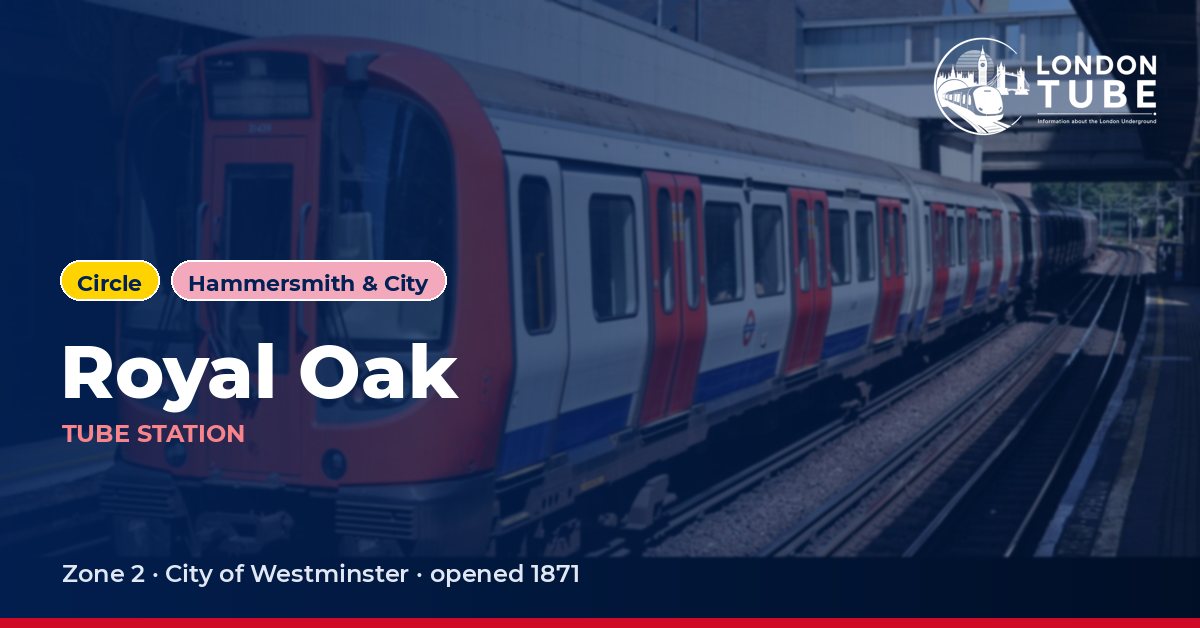
Royal Oak tube station
Circle line and Hammersmith & City line · Zone 2 · City of Westminster
About Royal Oak station
A pub supplied the name: the station takes it from “The Royal Oak” nearby, later called “The Railway Tap” and now “The Porchester”. Royal Oak opened on 30 October 1871, under an agreement between the Great Western Railway and the Metropolitan Railway, the co-owners of the Hammersmith & City. Access was from Lord Hill’s Bridge, between it and Ranelagh Bridge, and for over sixty years it was the first stop out of Paddington for main line trains. It is still the first stop for Hammersmith & City services.
Originally it had three platform faces, but quadrupling of the Great Western main line cut it to two, and a dive-under known as Subway Tunnel, opened on 12 May 1878 between here and Westbourne Park, let Hammersmith & City trains cross the main line. Main line trains stopped calling on 1 October 1934, and London Transport only took ownership on 1 January 1970. The station was damaged in the 1940–41 Blitz. Opposite stood Ranelagh Bridge depot, opened in 1907 with a turntable, water tower and coaling stage so locomotives need not make a 6-mile round trip from Paddington; it closed in 1980. A 2018 idea to build a replacement for Victoria Coach Station beside the station was ruled out by the Mayor on 13 March 2019.
First and last trains from Royal Oak
| Line and direction | Mon–Thu first – last | Friday first – last | Saturday first – last | Sunday first – last |
|---|---|---|---|---|
| Circle towards Hammersmith (Circle and H&C lines) | 05:24 – 00:58 | 05:24 – 00:58 | 05:24 – 00:58 | 07:37 – 00:45 |
| Circle towards Edgware Road (Circle line), Aldgate or King's Cross St Pancras | 04:50 to Aldgate – 00:41 | 04:50 to Aldgate – 00:41 | 04:50 to Aldgate – 00:41 | 06:33 – 23:51 to Aldgate |
| Hammersmith & City towards Hammersmith (Circle and H&C lines) | 05:46 – 00:52 | 05:46 – 00:52 | 05:46 – 00:52 | 07:13 – 00:30 |
| Hammersmith & City towards Barking or Plaistow | 05:13 – 00:33 | 05:13 – 00:33 | 05:13 – 00:33 | 07:01 – 00:10 |
Times are TfL’s published timetable departures from this station; on Saturday the list follows TfL’s “Saturdays and public holidays” timetable.
At the busiest hour on a weekday there are up to 7 Circle trains an hour per direction and 7 Hammersmith & City trains an hour per direction from Royal Oak, counting both directions separately.
Next stations from Royal Oak
Running times between Royal Oak and the adjoining stations, from TfL’s timetable.
| Line | Next station | Time |
|---|---|---|
| Circle | Paddington (H&C line) | 2 min |
| Circle | Westbourne Park | 2 min |
| Hammersmith & City | Paddington (H&C line) | 1.8 min |
| Hammersmith & City | Westbourne Park | 1.9 min |
Connections
- Tube: change here between the Circle line and Hammersmith & City line.
Station facilities
What is near Royal Oak station
Sitting on Lord Hill’s Bridge close to the elevated Westway, the station is quiet for most of the year but becomes extremely busy during the annual Notting Hill Carnival. Paddington Children’s Library is only about 90 m away and Paddington Library about 180 m. Within a few minutes are the Royal Oak (Meanwhile 2) Skatepark at 170 m, Porchester Square at 190 m, Westbourne Gardens at 240 m and Westbourne Green Open Space at 260 m. The Grand Junction arts centre (370 m) and the Canal Cafe Theatre (380 m) are also close. Paddington is the next stop east.
| Place | Walk from the station |
|---|---|
| Westbourne Gardens | 240 m |
| Canal Cafe Theatre | 380 m |
| Paddington Children’s Library | 90 m |
| Paddington Library | 180 m |
| Porchester Square | 190 m |
| Westbourne Green Open Space | 260 m |
Frequently asked questions
It is named after a nearby public house, “The Royal Oak”. The pub was later renamed “The Railway Tap” and is now called “The Porchester”, but the station has kept the original name since it opened in 1871.
Yes. From 1871 the station was served by both Great Western main line trains and Hammersmith & City trains, and for over sixty years it was the first stop out of Paddington on the main line. Main line trains ceased to call on 1 October 1934.