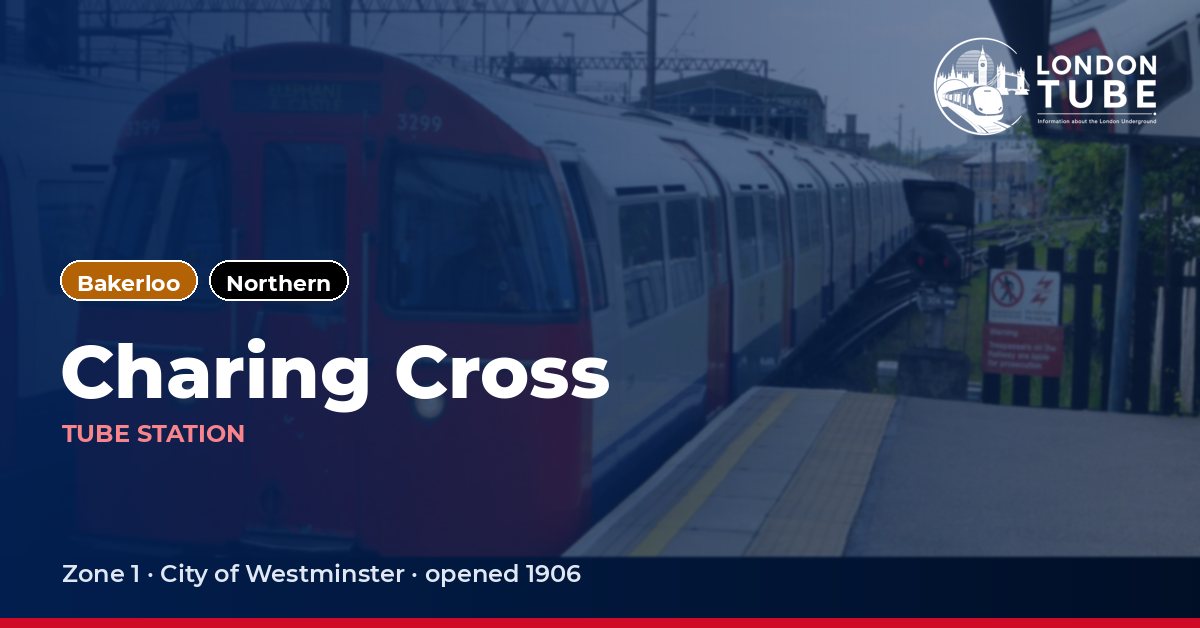
Charing Cross tube station
Bakerloo line and Northern line · Zone 1 · City of Westminster
About Charing Cross station
For most of their lives these were two separate stations with other names. The Baker Street and Waterloo Railway opened its platforms on 10 March 1906 as Trafalgar Square, and the Charing Cross, Euston and Hampstead Railway followed in 1907 with a station first called Charing Cross, then Charing Cross (Strand) from 1914 and Strand from 1915. In the 1970s new passageways joined the two in preparation for the Jubilee line, and when its platforms opened in 1979 the combined station took the name Charing Cross. Jubilee trains stopped calling in 1999, when that line was extended to Stratford.
Long before any of it was built, Charing Cross attracted schemes that never happened. Approved in 1865, the Waterloo and Whitehall Railway began work on a pneumatic line in which fans would push and pull carriages through tubes under the Thames, but work stopped in 1866. In 1882 the Charing Cross and Waterloo Electric Railway won approval for the first British scheme to propose electric traction, backed by Sir William Siemens, but it was abandoned in 1885. Today the Bakerloo and Northern lines meet here beneath the main-line terminus.
First and last trains from Charing Cross
| Line and direction | Mon–Thu first – last | Friday first – last | Saturday first – last | Sunday first – last |
|---|---|---|---|---|
| Bakerloo towards Elephant & Castle or Waterloo | 05:57 – 00:34 | 05:57 – 00:34 | 05:57 – 00:34 | 07:33 – 23:53 |
| Bakerloo towards Queen's Park, Harrow & Wealdstone or Stonebridge Park | 05:43 to Harrow & Wealdstone – 00:29 | 05:43 to Harrow & Wealdstone – 00:29 | 05:43 to Harrow & Wealdstone – 00:29 | 07:22 to Harrow & Wealdstone – 23:43 |
| Northern towards Battersea Power Station, Kennington or Morden | 05:56 to Morden – 00:34 to Morden | 05:56 to Morden – all night | 24 hours | all night – 23:44 to Morden |
| Northern towards High Barnet, Edgware or Mill Hill East | 05:41 – 00:38 to Edgware | 05:41 – all night | 24 hours | all night – 23:42 |
Times are TfL’s published timetable departures from this station; on Saturday the list follows TfL’s “Saturdays and public holidays” timetable.
At the busiest hour on a weekday there are up to 18 Bakerloo trains an hour per direction and 24 Northern trains an hour per direction from Charing Cross, counting both directions separately.
Next stations from Charing Cross
Running times between Charing Cross and the adjoining stations, from TfL’s timetable.
| Line | Next station | Time |
|---|---|---|
| Bakerloo | Embankment | 1 min |
| Bakerloo | Piccadilly Circus | 1.6 min |
| Northern | Embankment | 1.1 min |
| Northern | Leicester Square | 1.4 min |
Connections
- Tube: change here between the Bakerloo line and Northern line.
- Buses: 26, 87, 91, 139, 176 (night buses N155, N199, N21, N26, N343, N44, N87, N89, N91).
- National Rail: Southeastern.
Station facilities
What is near Charing Cross station
Entrances in Trafalgar Square, Strand, Villiers Street, Adelaide Street, William IV Street and the main-line station make this the gateway to Trafalgar Square, about 110 m away. Nelson’s Column is around 60 m from the station, with the statue of Charles I and the plaque marking the central point for London mileages at just 30 m. Admiralty Arch is roughly 120 m away, the Trafalgar Theatre 100 m, St Martin-in-the-Fields 160 m and Benjamin Franklin House 170 m. The National Gallery and National Portrait Gallery are also close, as are Whitehall and The Mall.
| Place | Walk from the station |
|---|---|
| Mileage Central Point of London Plaque (memorial) | 30 m |
| Charles I (statue) | 30 m |
| Nelson's Column | 60 m |
| Henry Havelock (statue) | 60 m |
| Charles James Napier (statue) | 90 m |
| Trafalgar Theatre | 100 m |
| George IV (statue) | 110 m |
| Trafalgar Square | 110 m |
Frequently asked questions
The Bakerloo line platforms were called Trafalgar Square from 1906 to 1979. The Northern line station opened in 1907 as Charing Cross, became Charing Cross (Strand) in 1914 and Strand in 1915. The two were joined in the 1970s and took the shared name Charing Cross in 1979.
Yes. The Jubilee line platforms opened in 1979, when the station got its current name. Jubilee line services to Charing Cross ended in 1999, when the line was extended to Stratford.