
Chalk Farm tube station
Northern line · Zone 2 · Camden
About Chalk Farm station
Adelaide Road was one name considered for this stop before the Charing Cross, Euston & Hampstead Railway opened it on 22 June 1907. Trains first ran between Golders Green and Charing Cross; after the City and South London Railway reached Camden Town in 1924 the two lines were joined, and Bank branch trains could run through as well. The ‘UndergrounD’ lettering on the building was added in 1908 as part of a network-wide signing scheme.
Leslie Green designed the stations for all three UERL tube lines opened in 1906 and 1907, and this narrow, wedge-shaped one has the longest frontage of them all, wrapped around the sharp corner where Haverstock Hill meets Adelaide Road. Its lift shafts, at 21 ft, are the shallowest of any Underground station. Tube Lines completed a refurbishment in 2005, and the building is Grade II listed.
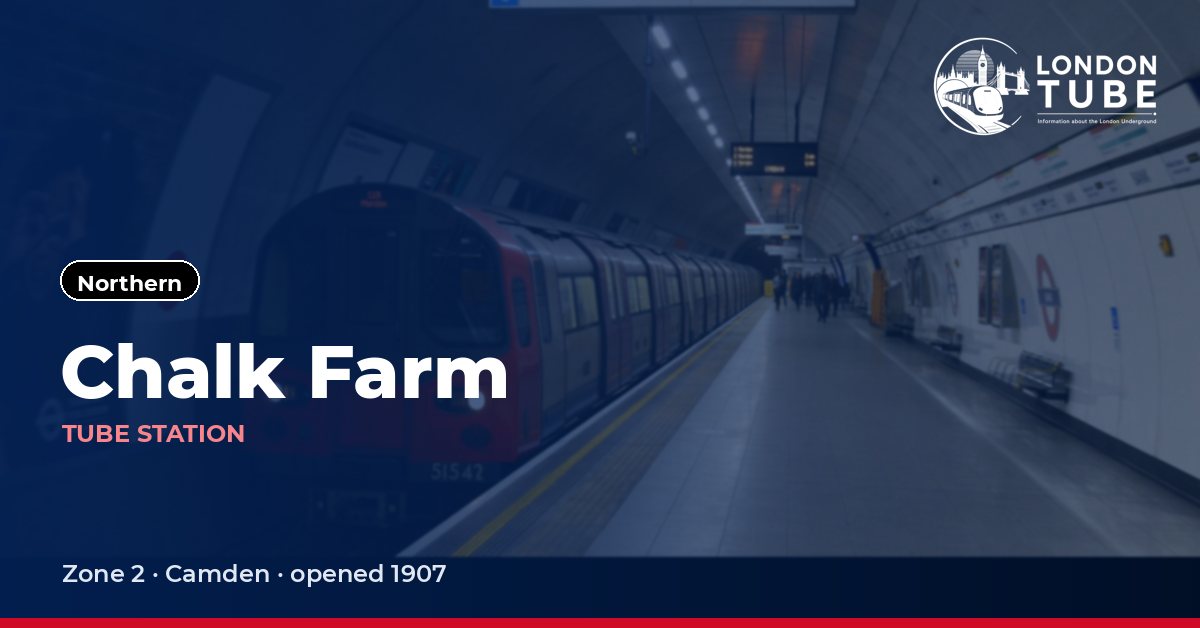
First and last trains from Chalk Farm
| Line and direction | Mon–Thu first – last | Friday first – last | Saturday first – last | Sunday first – last |
|---|---|---|---|---|
| Northern towards Morden, Kennington or Battersea Power Station | 05:43 – 00:21 | 05:43 – all night | 24 hours | all night – 23:31 |
| Northern towards Edgware or Golders Green | 06:00 – 00:52 | 06:00 – all night | 24 hours | all night – 23:56 |
Times are TfL’s published timetable departures from this station; on Saturday the list follows TfL’s “Saturdays and public holidays” timetable.
At the busiest hour on a weekday there are up to 25 Northern trains an hour per direction from Chalk Farm, counting both directions separately.
Next stations from Chalk Farm
Running times between Chalk Farm and the adjoining stations, from TfL’s timetable.
| Line | Next station | Time |
|---|---|---|
| Northern | Belsize Park | 1.6 min |
| Northern | Camden Town | 1.9 min |
Connections
Chalk Farm is served by the Northern line only; there is no interchange with other rail lines here.
Station facilities
What is near Chalk Farm station
The station stands on the angular junction that forms the centre of the Chalk Farm neighbourhood. The Roundhouse is about 140 m away. Smaller galleries are close by: Koppel Collective at around 40 m, the Zabludowicz Collection at 220 m and Gallery 196 at 230 m. The Fiddler’s Elbow pub is about 270 m off, the memorial to Dr Bhimrao Ramji Ambedkar roughly 310 m, and Chalcot Square Gardens about 360 m. Bus routes 1, 31 and 393 call here.
| Place | Walk from the station |
|---|---|
| Roundhouse | 140 m |
| Koppel Collective | 40 m |
| Zabludowicz Collection | 220 m |
| Gallery 196 | 230 m |
| The Fiddler's Elbow | 270 m |
| Dr Bhimrao Ramji Ambedkar (memorial) | 310 m |
| Chalcot Square Gardens | 360 m |
Frequently asked questions
It fills a wedge-shaped site at the sharp junction of Haverstock Hill and Adelaide Road. Leslie Green’s design gives it the longest frontage of any of the stations he designed for the three UERL tube lines opened in 1906 and 1907. The building is Grade II listed.
Yes. Its lift shafts are 21 ft deep, the shallowest of any London Underground station. The station has no escalators: two lifts carry passengers between street level and the Edgware branch platforms of the Northern line.