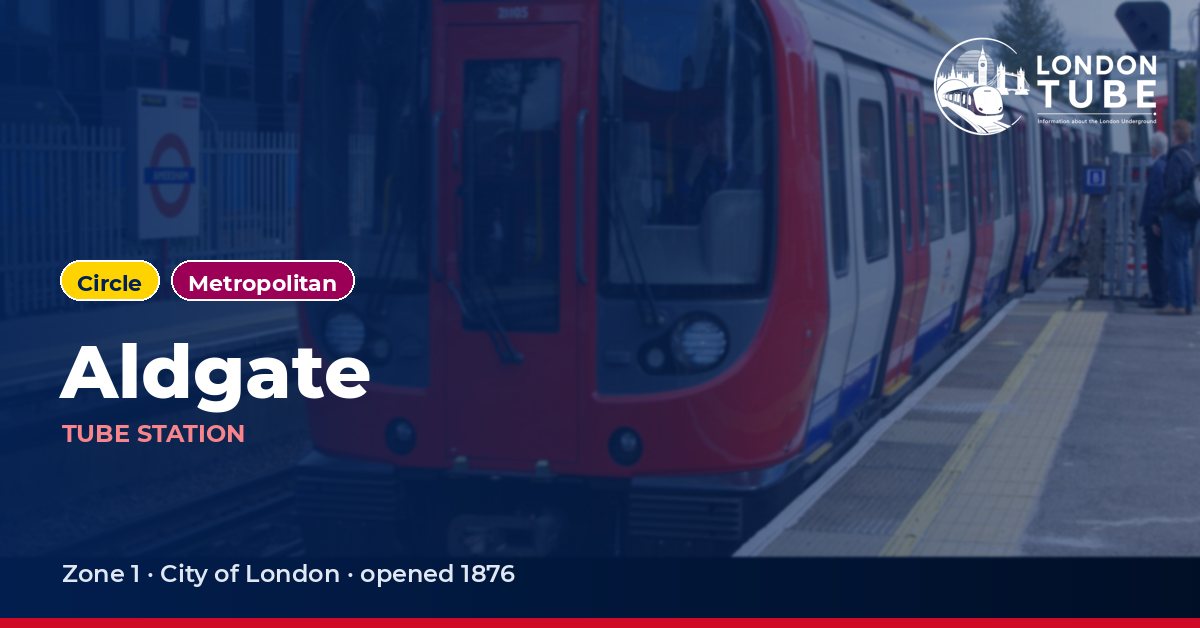
Aldgate tube station
Circle line and Metropolitan line · Zone 1 · City of London
About Aldgate station
Building Aldgate was slow and expensive. The route was first drawn south from Moorgate to Cannon Street, then bent to reach Liverpool Street, Broad Street and Fenchurch Street, which forced an awkward doubling-back here and land purchases at City prices. The site also lay on a plague pit behind St Botolph’s Aldgate, estimated to hold some 1,000 bodies. The station finally opened on 18 November 1876, and the southward link to Tower Hill on 25 September 1882 completed the Circle. Trains once ran from here as far west as Richmond; since 1941 Aldgate has been the eastern end of the Metropolitan line.
The 1876 train shed still stands, hidden from the street behind a frontage of 1926 by Charles Walter Clark, the Metropolitan Railway’s chief architect. Its six-bay façade is clad in white faïence, with 1920s shopfronts on green marble and pink granite, a half-hexagonal glass canopy hung from metal ties, leaded first-floor windows and a frieze carrying the Metropolitan Railway monogram. On 7 July 2005 a bomb exploded on a Circle line train approaching from Liverpool Street, killing seven passengers. Of the stations affected that day, Aldgate was the first to reopen once the police handed the site back.
First and last trains from Aldgate
| Line and direction | Mon–Thu first – last | Friday first – last | Saturday first – last | Sunday first – last |
|---|---|---|---|---|
| Circle towards Hammersmith (Circle and H&C lines) or Edgware Road (Circle line) | 05:36 – 00:41 to Edgware Road (Circle line) | 05:36 – 00:41 to Edgware Road (Circle line) | 05:36 – 00:41 to Edgware Road (Circle line) | 07:26 – 00:23 |
| Circle towards Edgware Road (Circle line) | 05:27 – 00:08 | 05:27 – 00:08 | 05:27 – 00:08 | 07:00 – 23:47 |
| Metropolitan towards Uxbridge, Watford or Amersham | 06:16 – 00:13 | 06:16 – 00:13 | 06:18 to Amersham – 00:13 | 07:38 – 23:59 |
Times are TfL’s published timetable departures from this station; on Saturday the list follows TfL’s “Saturdays and public holidays” timetable.
At the busiest hour on a weekday there are up to 7 Circle trains an hour per direction and 16 Metropolitan trains an hour per direction from Aldgate, counting both directions separately.
Next stations from Aldgate
Running times between Aldgate and the adjoining stations, from TfL’s timetable.
| Line | Next station | Time |
|---|---|---|
| Circle | Liverpool Street | 2.2 min |
| Circle | Tower Hill | 3.9 min |
| Metropolitan | Liverpool Street | 1.9 min |
Connections
- Tube: change here between the Circle line and Metropolitan line.
Station facilities
What is near Aldgate station
Aldgate sits on the eastern edge of the City of London, where the Square Mile meets Whitechapel, and its riders are largely office workers and students. Aldgate bus station is about 90 m away. Within a few minutes’ walk are the Artizan Street Library and Community Centre (about 160 m), the small Braham Street Park (190 m), London Metropolitan University’s Aldgate campus (200 m) and the churchyard of St Katharine Cree (210 m). Wentworth Street Market lies about 270 m off, Toynbee Studios about 350 m, and Coventry University’s London campus about 380 m.
| Place | Walk from the station |
|---|---|
| Aldgate Station | 90 m |
| Artizan Street Library and Community Centre | 160 m |
| Library | 170 m |
| Braham Street Park | 190 m |
| London Metroplitan University: Aldgate Campus | 200 m |
| St Katharine Cree Churchyard | 210 m |
| Wentworth Street Market | 270 m |
| London College of Marketing and Technology | 310 m |
Frequently asked questions
The line was realigned to serve Liverpool Street, Broad Street and Fenchurch Street, which brought the station onto a plague pit behind St Botolph’s Aldgate, thought to contain around 1,000 bodies. That burial ground delayed construction, and the station did not open until 18 November 1876.
Yes. The 1876 train shed over the platforms survives, though it cannot be seen from the street. It is screened by the frontage building of 1926, designed by Charles Walter Clark, which keeps its white faïence cladding, 1920s shopfronts and a frieze with the Metropolitan Railway monogram.