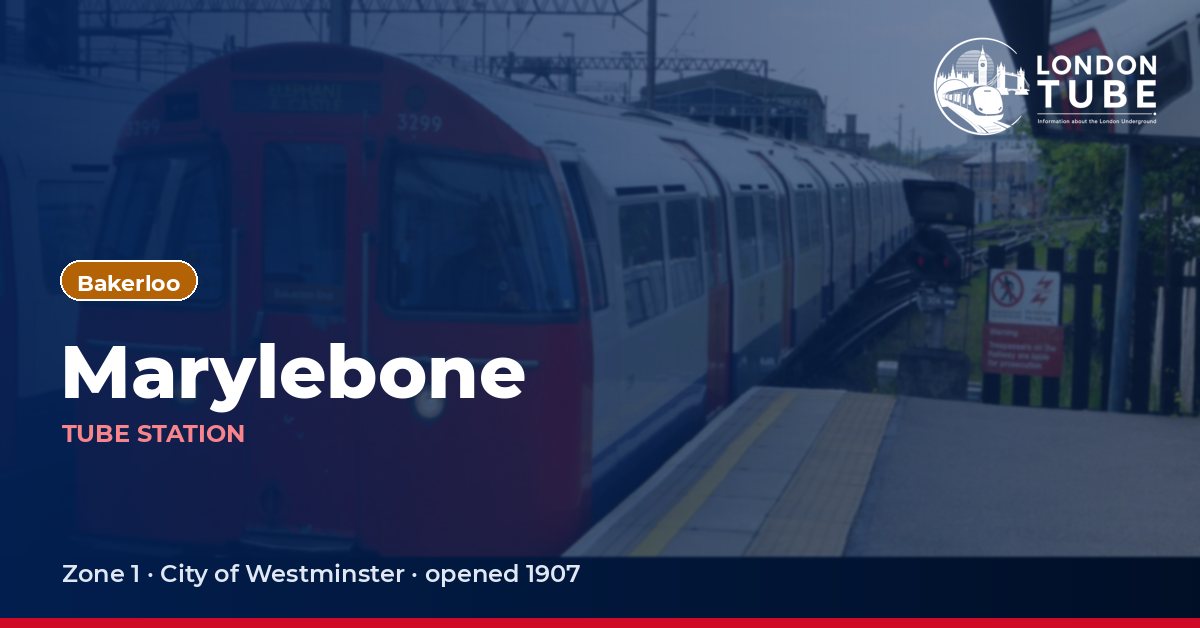
Marylebone tube station
Bakerloo line · Zone 1 · City of Westminster
About Marylebone station
The last of London’s main line termini to be built, and one of the smallest, Marylebone opened to passengers on 15 March 1899 as the end of the Great Central Railway’s London extension. Its approach ran through a cut-and-cover tunnel under Lord’s, dug between September 1896 and May 1897 so that no cricket had to be cancelled. Money ran short, so only four of the eight planned platforms were built, leaving an unusually long concourse. The modest building by the company’s civil engineer Henry William Braddock is a domestic version of the Wrenaissance revival style, with Dutch gables, warm brick, cream-coloured stone and the GCR crest worked into its railings.
The Bakerloo line platforms opened on 27 March 1907 under the name Great Central, which they kept until 1917, and the Bakerloo has remained the only Underground line here. The main line station came close to disappearing: traffic declined after the Great Central Main Line closed, and by the 1980s Marylebone was threatened with closure before commuter traffic from Aylesbury and High Wycombe saved it. From 1993 it became the terminus of the Chiltern Main Line to Birmingham. As of 2020 it was the only main London terminus served solely by diesel trains, and its relative quietness has made it a popular filming location.
First and last trains from Marylebone
| Line and direction | Mon–Thu first – last | Friday first – last | Saturday first – last | Sunday first – last |
|---|---|---|---|---|
| Bakerloo towards Elephant & Castle or Waterloo | 05:48 – 00:25 | 05:48 – 00:25 | 05:48 – 00:25 | 07:24 – 23:44 |
| Bakerloo towards Queen's Park, Harrow & Wealdstone or Stonebridge Park | 05:52 to Harrow & Wealdstone – 00:38 | 05:52 to Harrow & Wealdstone – 00:38 | 05:52 to Harrow & Wealdstone – 00:38 | 07:31 to Harrow & Wealdstone – 23:52 |
Times are TfL’s published timetable departures from this station; on Saturday the list follows TfL’s “Saturdays and public holidays” timetable.
At the busiest hour on a weekday there are up to 18 Bakerloo trains an hour per direction from Marylebone, counting both directions separately.
Next stations from Marylebone
Running times between Marylebone and the adjoining stations, from TfL’s timetable.
| Line | Next station | Time |
|---|---|---|
| Bakerloo | Baker Street | 1.2 min |
| Bakerloo | Edgware Road (Bakerloo line) | 1.3 min |
Connections
- National Rail: Chiltern Railways.
Station facilities
What is near Marylebone station
The station stands on Melcombe Place, just north of Marylebone Road, with Chiltern trains to High Wycombe, Aylesbury, Oxford and Birmingham, and several bus routes. The Bomb Factory Art Foundation is about 120 m away, the Nightingale Hospital about 150 m and Dorset Square about 170 m. Westminster Magistrates’ Court is around 220 m from the station and the London Business School about 240 m. The Marylebone Theatre is about 340 m away, and the Sherlock Holmes Museum, 221B Baker Street and the London Beatles Store are all roughly 360 m, with the Lisson Gallery at about 380 m.
| Place | Walk from the station |
|---|---|
| Dorset Square | 170 m |
| Sherlock Holmes Museum | 360 m |
| 221B Baker Street | 360 m |
| Lisson Gallery | 380 m |
| Nightingale Hospital | 150 m |
| Westminster Magistrates' Court | 220 m |
| London Business School | 240 m |
| Marylebone Theatre | 340 m |
Frequently asked questions
Yes. When the Bakerloo line platforms opened on 27 March 1907 they were named Great Central, after the railway whose London terminus they served. The station carried that name until 1917, when it became Marylebone, matching the main line station above.
Objections over the route through Lord’s delayed the line in the 1890s. Sir Edward Watkin promised the ground would not be disrupted, and the approach was built as a cut-and-cover tunnel between September 1896 and May 1897, so no cricket was cancelled. The station opened to passengers on 15 March 1899.