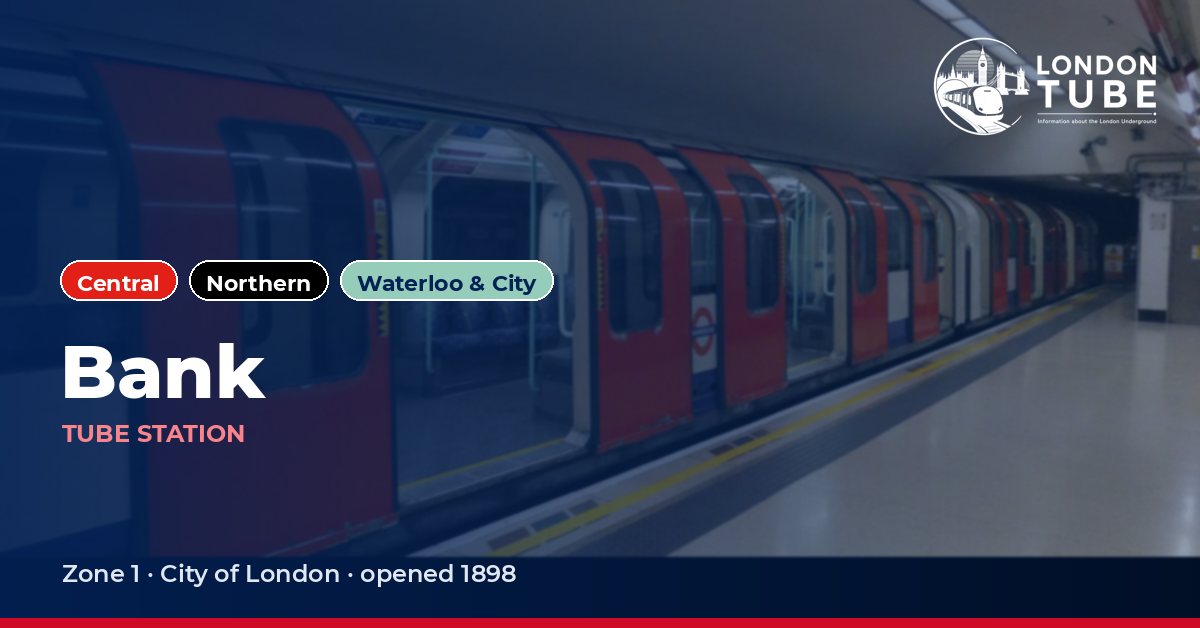
Bank tube station
Central line, Northern line and Waterloo & City line · Zone 1 · City of London
About Bank station
Bank grew out of three separate railways that all wanted to reach the heart of the City. First came the Waterloo & City, whose platforms under Queen Victoria Street opened on 8 August 1898 as City; they took the name Bank only on 28 October 1940. The City & South London followed on 25 February 1900. It had planned to demolish the church of St Mary Woolnoth and build a station called Lombard Street on the site, but after public protest it put its ticket hall and lifts in the church’s crypt instead, moving the bodies and underpinning the foundations. On 30 July 1900 the Central London Railway opened its eastern terminus beneath the road junction itself. To avoid paying property owners, its tunnels follow the streets above, so the platforms under Threadneedle Street and Poultry curve so sharply that one end cannot be seen from the other.
An escalator link to Monument opened on 18 September 1933, joining the two into one interchange. On 11 January 1941 a bomb scored a direct hit on the Central line ticket hall, killing 56 people. The Waterloo & City gained moving walkways in 1960, the DLR arrived in 1991, and a new entrance at Bloomberg’s headquarters on Walbrook opened on 30 November 2018. A major upgrade and expansion of the complex, one of the busiest on the network, was completed in 2023 after seven years of work.
First and last trains from Bank
| Line and direction | Mon–Thu first – last | Friday first – last | Saturday first – last | Sunday first – last |
|---|---|---|---|---|
| Central towards West Ruislip, Ealing Broadway or White City | 05:48 – 00:25 | 05:48 – all night | 24 hours | all night – 23:40 to Ealing Broadway |
| Central towards Hainault, Epping or Loughton | 05:56 to Epping – 00:38 to Epping | 05:56 to Epping – all night | 24 hours | all night – 23:50 |
| Northern towards Morden | 05:58 – 00:38 | 05:58 – 00:38 | 05:58 – 00:38 | 07:31 – 23:47 |
| Northern towards Edgware, High Barnet or Mill Hill East | 05:46 – 00:34 to High Barnet | 05:46 – 00:34 to High Barnet | 05:46 – 00:34 to High Barnet | 07:26 to High Barnet – 23:39 to High Barnet |
| Waterloo & City towards Waterloo | 06:06 – 00:26 | 06:06 – 00:26 | No service | No service |
Times are TfL’s published timetable departures from this station; on Saturday the list follows TfL’s “Saturdays and public holidays” timetable.
At the busiest hour on a weekday there are up to 30 Central trains an hour per direction, 25 Northern trains an hour per direction and 19 Waterloo & City trains an hour per direction from Bank, counting both directions separately.
Next stations from Bank
Running times between Bank and the adjoining stations, from TfL’s timetable.
| Line | Next station | Time |
|---|---|---|
| Central | Liverpool Street | 2.1 min |
| Central | St Paul's | 2 min |
| Northern | London Bridge | 1.9 min |
| Northern | Moorgate | 2.1 min |
| Waterloo & City | Waterloo | 3.5 min |
Connections
- Tube: change here between the Central line, Northern line and Waterloo & City line.
- Buses: 8, 21, 25, 26, 43, 133, 141 (night buses N21, N242, N25, N26, N550, N551, N8).
- DLR at this station.
Station facilities
What is near Bank station
Bank serves the City of London. The Bank of England, after which the station is named, is about 150 m away, with the Royal Exchange at about 210 m and the statue of the Duke of Wellington at 120 m. A statue of the tunnelling engineer James Henry Greathead stands outside the station beside the Royal Exchange. The London Mithraeum, the remains of a Roman temple, lies only about 90 m from the station, while St Mary-le-Bow (250 m), the Guildhall Art Gallery (290 m), Guildhall (330 m) and the One New Change shopping centre (390 m) are all within a short walk.
| Place | Walk from the station |
|---|---|
| London Mithraeum | 90 m |
| Duke of Wellington (statue) | 120 m |
| Bank of England War Memorial | 140 m |
| London Troops War Memorial | 140 m |
| Bank of England | 150 m |
| Royal Exchange | 210 m |
| St. Mary-Le-Bow | 250 m |
| Guildhall Art Gallery | 290 m |
Frequently asked questions
When the DLR was extended to Bank in 1991, a new link was dug between the Waterloo & City and Central lines. The work uncovered part of one of the Greathead tunnelling shields used to build the Waterloo & City line, and the shield was built into the new passageway, so passengers walk through it when changing between those lines.
The City & South London Railway wanted to demolish the 18th-century church of St Mary Woolnoth and build a station on the site. After public protest it built only a ticket hall and lift entrance in the crypt instead, strengthening it with a steel frame. That station opened on 25 February 1900.