
Cannon Street tube station
Circle line and District line · Zone 1 · City of London
About Cannon Street station
Underground trains have stopped at Cannon Street since 6 October 1884, beneath a terminus with a much older story. The South Eastern Railway chose the site, once the Steelyard used by Hanseatic merchants from the 10th century until 1598, to give itself a City terminus that could compete with the London, Chatham & Dover Railway. A new bridge over the Thames was built between 1863 and 1866, and the main-line station opened on 1 September 1866, designed by Sir John Hawkshaw and John Wolfe-Barry with two Wren-style towers 135 ft high facing the river. For a while a shuttle to Charing Cross was a popular way between the City and the West End, until the District Railway offered something more direct.
The main-line station was renovated by John Poulson in the late 1950s, and his building was replaced in 2007. It sits on a 700 ft brick viaduct over Upper Thames Street containing 27 million bricks, with the remains of Roman buildings beneath it forming a scheduled monument. The hotel that once fronted the station hosted the Foundation Congress of the Communist Party of Great Britain in July 1920 and appears in T. S. Eliot’s The Waste Land. Below street level the Circle and District lines run between Mansion House and Monument.
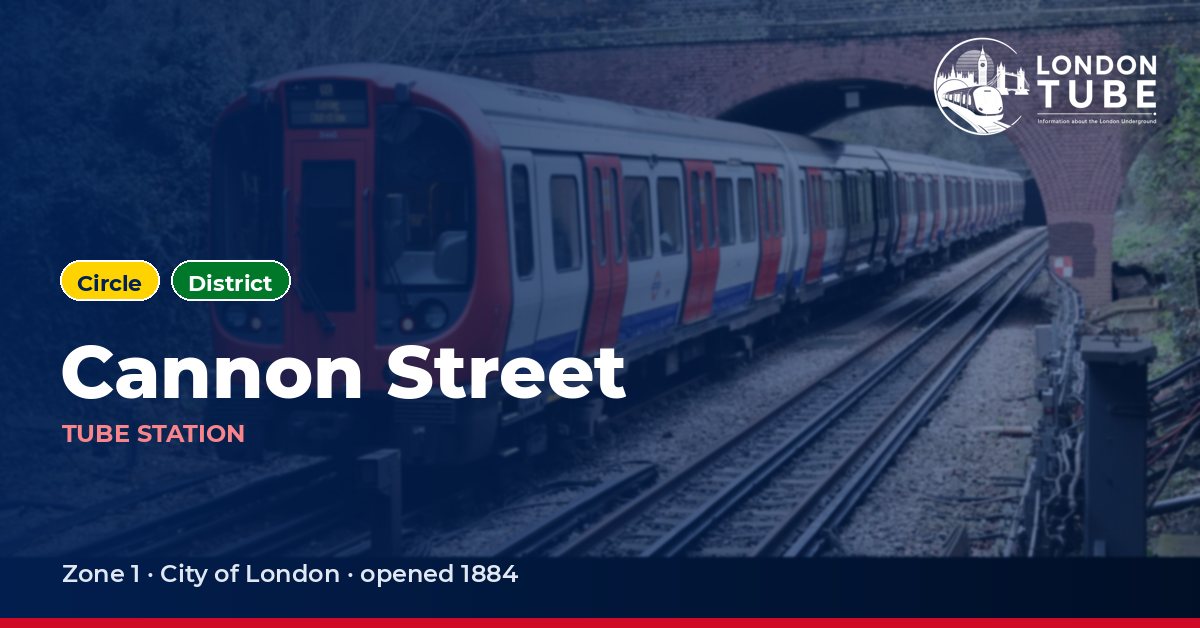
First and last trains from Cannon Street
| Line and direction | Mon–Thu first – last | Friday first – last | Saturday first – last | Sunday first – last |
|---|---|---|---|---|
| Circle towards Hammersmith (Circle and H&C lines), Aldgate or Edgware Road (Circle line) | 05:55 to Aldgate – 00:31 to Edgware Road (Circle line) | 05:55 to Aldgate – 00:31 to Edgware Road (Circle line) | 05:55 to Aldgate – 00:31 to Edgware Road (Circle line) | 07:33 to Aldgate – 00:06 |
| Circle towards Edgware Road (Circle line) | 05:33 – 00:13 | 05:33 – 00:13 | 05:33 – 00:13 | 07:06 – 23:52 |
| District towards Wimbledon, Ealing Broadway or Richmond | 05:42 to Richmond – 00:30 to Ealing Broadway | 05:42 to Richmond – 00:30 to Ealing Broadway | 05:42 – 00:30 to Ealing Broadway | 06:58 to Richmond – 23:54 |
| District towards Upminster, Tower Hill or Barking | 05:33 – 00:46 | 05:33 – 00:46 | 05:33 – 00:46 | 07:00 – 00:10 |
Times are TfL’s published timetable departures from this station; on Saturday the list follows TfL’s “Saturdays and public holidays” timetable.
At the busiest hour on a weekday there are up to 7 Circle trains an hour per direction and 23 District trains an hour per direction from Cannon Street, counting both directions separately.
Next stations from Cannon Street
Running times between Cannon Street and the adjoining stations, from TfL’s timetable.
| Line | Next station | Time |
|---|---|---|
| Circle | Mansion House | 1.1 min |
| Circle | Monument | 1.9 min |
| District | Mansion House | 1.4 min |
| District | Monument | 1.3 min |
Connections
- Tube: change here between the Circle line and District line.
- National Rail: Southeastern.
Station facilities
What is near Cannon Street station
Entrances on Cannon Street and Dowgate Hill lead into the heart of the City, with London Stone just to the north. The London Mithraeum is about 100 m away. Nearby church gardens include St Swithin’s at about 70 m and St Stephen Walbrook’s at around 140 m, alongside Whittington Garden. The Bank of England is about 320 m from the station, the Royal Exchange and St Mary-le-Bow around 330 m, and the Monument to the Great Fire of London roughly 350 m. Above, the main-line terminus runs Southeastern trains, mostly for commuters from south-east London and Kent.
| Place | Walk from the station |
|---|---|
| London Mithraeum | 100 m |
| Duke of Wellington (statue) | 260 m |
| London Troops War Memorial | 280 m |
| Bank of England War Memorial | 310 m |
| Bank of England | 320 m |
| St. Mary-Le-Bow | 330 m |
| Royal Exchange | 330 m |
| The Monument to the Great Fire of London | 350 m |
Frequently asked questions
The station was built on the Steelyard, the trading base in England of the Hanseatic League, used by its merchants from the 10th century until 1598. Under the brick viaduct carrying the station over Upper Thames Street lie the remains of several Roman buildings, now a scheduled monument.
The original station, designed by Sir John Hawkshaw and John Wolfe-Barry and opened in 1866, was approached across the Thames by its own railway bridge. Its two Christopher Wren-style towers, 135 ft high, faced the river and supported an iron train shed 700 ft long.