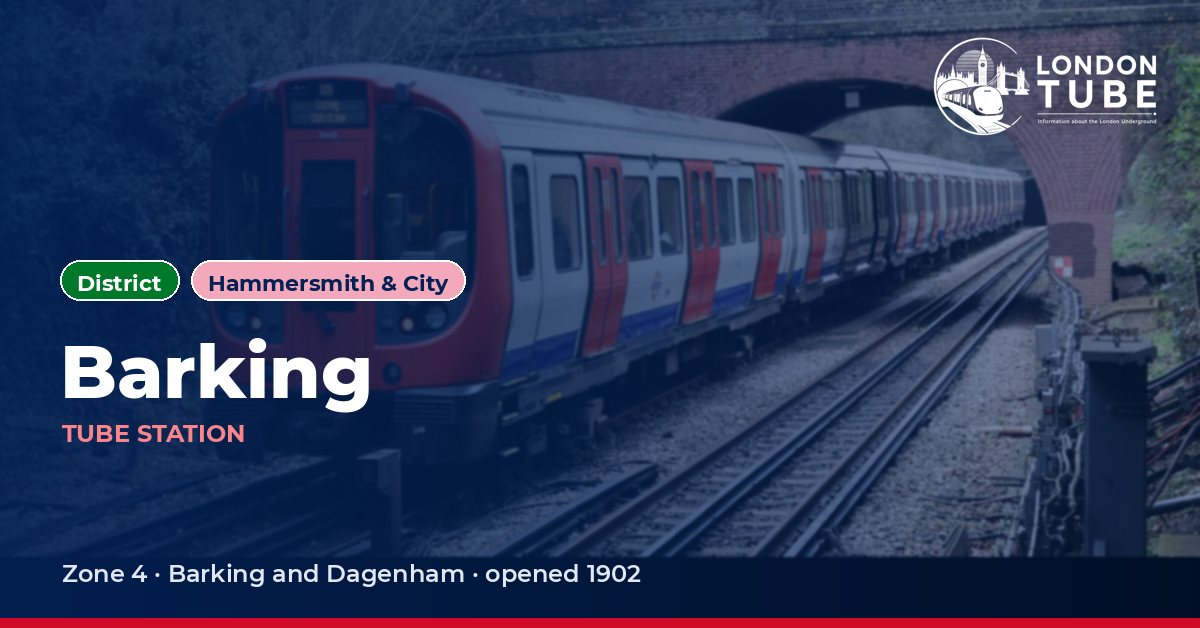
Barking tube station
District line and Hammersmith & City line · Zone 4 · Barking and Dagenham
About Barking station
Barking was a railway town decades before the Underground arrived. The London, Tilbury and Southend Railway reached it in 1854, on its first line from Forest Gate Junction; a more direct route to Fenchurch Street came in 1858 and a faster line towards Southend was built between 1885 and 1888. District Railway trains first called on 2 June 1902, electric District services arrived on 1 April 1908, and in 1936 Metropolitan trains from Hammersmith were extended here to relieve the overcrowded District. That service is now the Hammersmith & City line, which ends at Barking.
The building you enter dates from 1961, when the Queen opened the new booking hall. It was designed by a team of British Railways Eastern Region architects led by John Ward: a precast concrete and glass hall whose roof projects forward as a canopy over the street. Pevsner judged it one of the best English stations of its date and saw in it an echo of Rome’s Termini, and it has been Grade II listed since 24 November 1995. The rebuild also added two flyovers and a dive-under on either side, separating Underground and main-line tracks so that District and Fenchurch Street trains can share island platforms. There are nine platform faces serving eight tracks, and some 1908 canopy sections survive among the 1961 ones.
First and last trains from Barking
| Line and direction | Mon–Thu first – last | Friday first – last | Saturday first – last | Sunday first – last |
|---|---|---|---|---|
| District towards Richmond, Ealing Broadway or Wimbledon | 05:15 – 00:01 to Ealing Broadway | 05:15 – 00:01 to Ealing Broadway | 05:15 – 00:01 to Ealing Broadway | 05:56 to Whitechapel – 23:27 |
| District towards Upminster or Dagenham East | 05:45 – 01:17 | 05:45 – 01:17 | 05:45 – 01:17 | 06:30 – 00:42 |
| Hammersmith & City towards Hammersmith (Circle and H&C lines) | 05:02 – 23:59 | 05:02 – 23:59 | 05:02 – 23:59 | 06:27 – 22:59 |
Times are TfL’s published timetable departures from this station; on Saturday the list follows TfL’s “Saturdays and public holidays” timetable.
At the busiest hour on a weekday there are up to 20 District trains an hour per direction and 7 Hammersmith & City trains an hour per direction from Barking, counting both directions separately.
Connections
- Tube: change here between the District line and Hammersmith & City line.
- National Rail: c2c.
- London Overground: Suffragette line.
Station facilities
What is near Barking station
Barking is one of east London’s bigger interchanges, where the Underground meets c2c trains on the London, Tilbury and Southend line and the Overground’s Suffragette line to Gospel Oak and Barking Riverside. The station is on Station Parade, in the town centre. Vicarage Field Shopping Centre is about 140 m away, A House for Artists about 230 m, Barking Central Arboretum around 300 m and the Folly Wall about 340 m. Barking Learning Centre is roughly 390 m from the station.
| Place | Walk from the station |
|---|---|
| Barking Learning Centre | 390 m |
| Vicarage Field Shopping Centre | 140 m |
| Barking Central Arboretum | 300 m |
Frequently asked questions
The booking hall, footbridge, staircases and platform buildings of 1961 were designed by British Railways Eastern Region architects led by John Ward. Its concrete and glass hall with a forward-projecting canopy was praised by Pevsner as one of the best English stations of its date. It has been Grade II listed since 24 November 1995.
District Railway trains began calling at Barking on 2 June 1902, when the Whitechapel and Bow Railway opened, and electric District services started on 1 April 1908. Metropolitan trains from Hammersmith followed in 1936; since 30 July 1990 that route has been the Hammersmith & City line.